

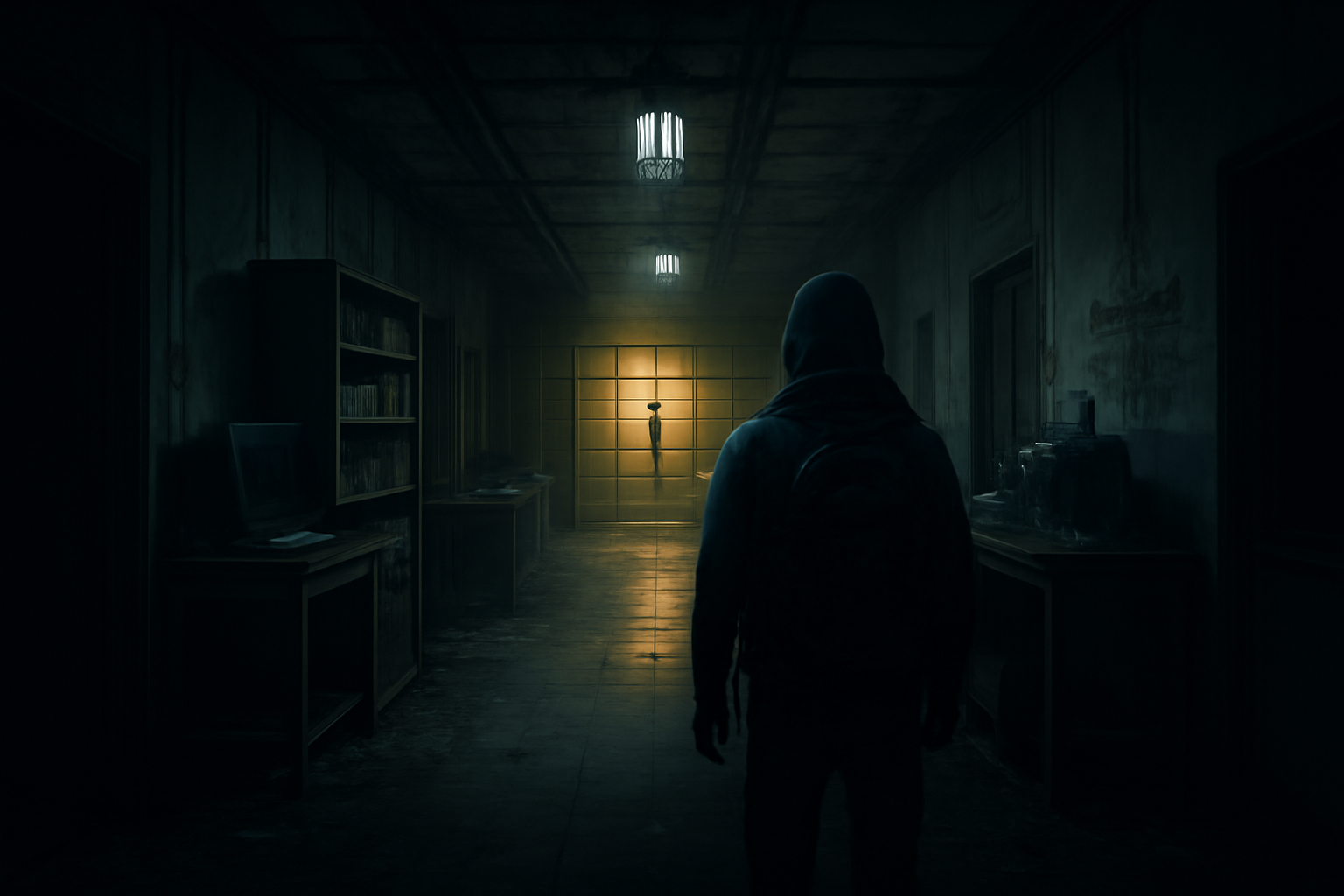
The Kessler Research Institute had been abandoned for fourteen years.
Everyone agreed it should’ve been demolished, but the government preferred secrets over safety. So the facility stayed sealed, rotting quietly in the mountains.
Until last Tuesday, when the lights came back on.
Dr. Mara Helix stared at the live feed from the security drone — the first drone that had managed to get inside. Dust swirled in the beam of the corridor lights, which flickered with a rhythmic, almost purposeful pulse.
“Who restored the power?” she muttered.
“According to the logs,” said her partner, Jonah Braddock, “no one.”
The drone’s spotlight passed over a sign: SUBLEVEL C — BIOARCHIVE 2.
Mara felt her stomach twist.
“That’s the floor where the anomalies were stored.”
Jonah shot her a look. “All the anomalies were removed when the lab closed.”
“Were they?” Mara whispered.
The drone paused as if listening. Mara checked the telemetry — no wind, no movement, no reason for the hesitation.
“Pull it back,” she said. “I don’t trust the signal.”
Jonah tapped the controls.
The drone didn’t move.
Then the corridor lights shut off.
All at once.
The feed went black.
Mara’s breath hitched. “Reboot it!”
Jonah hammered the command keys. “It’s not responding—”
A light blinked on in the drone camera.
Not the corridor lights.
A single LED, glowing red.
A message appeared on the screen:
YOU LEFT.
WE DIDN’T.
Mara stood up so fast her chair toppled.
“Power it down! Hard kill!”
Jonah slammed the emergency cutoff.
The screen went dead.
Silence filled the monitoring tent.
Then, faintly, from the drone speaker — though it was fully powered off:
come back
Jonah backed away from the table. “Nope. No way. We’re not going in there.”
Mara didn’t answer.
Because she already knew they were.
They entered the main corridor at dawn.
The smell hit first — stale air, tinged with ozone and something metallic. Frost coated the interior windows, as if the whole facility had been refrigerated and thawed repeatedly.
Jonah swept his light over the walls.
“Paint’s peeling in… patterns,” he said.
Mara stepped closer.
It wasn’t peeling.
It was carved. Fine linear grooves, hundreds of them, etched into the paint down the length of the hall.
Like something had dragged its fingers across the surface, slowly, deliberately.
“The anomalies they kept here—” Jonah began.
“No,” Mara cut in. “They never got this far.”
She didn’t want to say what she was thinking:
Something stayed behind.
Something the evacuation team never found.
They reached the central stairwell. The lights flickered to life as they approached.
Not in a random surge.
In sequence.
Left to right.
Top to bottom.
As if acknowledging their presence.
Jonah swallowed hard. “It’s—responding.”
Mara kept her flashlight raised. “Or observing.”
They descended into Sublevel C.
The Bioarchive smelled worse than upstairs — sour, chemical decay mixed with a faint sweetness that made Jonah gag.
“Something ruptured,” he said, covering his face.
Mara scanned the rows of cryopods lining the walls. Most stood empty, doors cracked open, frost spilled across the concrete like ancient lace.
But one pod near the far corner remained intact.
Frosted over. Sealed.
Lights glowing softly.
“No way,” Mara whispered. “They said everything was removed.”
Jonah wiped the frost from the pod display.
There was no specimen ID.
No date.
No researcher tags.
Just an error message looping continuously:
UNABLE TO RELEASE
Jonah stepped back. “We’re leaving.”
Mara hovered her hand over the release panel.
“No,” he said sharply. “We don’t open anything down here.”
“Something restored power,” Mara said. “Something activated the lights. Something turned the drone back on. If it’s in this pod—”
“It’s not,” Jonah said. “Because look.”
He pointed.
Long grooves carved the concrete around the pod in straight radial lines, like a burst pattern. Some were deep. Too deep for metal tools.
Mara crouched.
“These weren’t carved.”
“How do you figure that?” Jonah asked.
She traced one line with her glove.
“No debris. No chips. These grooves weren’t made by force.”
She looked up slowly.
“They were made by heat.”
Jonah’s eyes widened. “But the temperature never—”
A low hum vibrated through the pod.
Lights flickered.
The pod’s frost shifted, sliding like liquid down the glass.
Inside, something moved.
“Back!” Jonah shouted, grabbing her, pulling her behind a row of cabinets.
The frost melted completely.
A silhouette stood inside.
Human-shaped.
Too thin.
Too tall.
Limbs slightly wrong in their proportions.
Its head tilted slowly toward the glass.
Then the lights flickered.
Once.
Twice.
On the third flicker, the pod door hung open.
Empty.
Jonah froze. “It’s out. It got out. It—”
A soft scrape cut him off.
Something moved across the metal floor behind them.
Slow.
Deliberate.
Mara pressed her back to the wall and raised her flashlight—
The beam caught it.
A shape halfway between human and something else. Skin—or something like it—slick and pale under the half-light. Limbs elongated. Fingers too long. The face lacked features except for faint impressions where eyes should have been.
It didn’t move toward them.
It moved with them.
Shadow to shadow.
Step for step.
Like it was learning.
Mara whispered, “It’s not attacking.”
Jonah whispered back, “Yet.”
The creature tilted its head at the sound.
Then, in a motion so fast it blurred, it sprinted past them and vanished down the corridor.
They found the drone in the next hallway.
Powered on.
Camera facing them.
A new message flashed across the display:
FOLLOW
Jonah shook his head. “No chance.”
Mara exhaled. “If it wanted us dead, we’d be dead.”
“That’s your scientific conclusion?”
“No.” She stared down the dark hallway where the creature vanished.
“That’s survival instinct.”
They followed the trail of melted grooves along the floor, each one fresh and faintly steaming. The path wound through storage chambers, past collapsed server rooms, down another flight into Sublevel D — a section never listed in the original lab schematics.
“How far does this place go?” Jonah muttered.
Farther than anyone knew.
The grooves ended at a large door covered in hazard seals.
Mara brushed dust from the warning label.
EXPERIMENTAL BEHAVIORAL LAB 4-B
ACCESS REVOKED 12 YEARS AGO
Jonah stared. “Behavioral? I thought this place studied biological anomalies.”
Mara’s breath frosted in the cold air. “Behavior is biology.”
The door slid open with a sigh.
Inside was a circular chamber with mirrored walls and a single observation desk in the center. Memory rushed back to Mara — old files, old rumors about what happened here during the final months.
“Mara,” Jonah whispered.
In the reflection of the mirrored walls, they saw the creature.
Standing behind them.
Watching.
Not attacking.
Just watching.
But in the reflected chamber, its form wasn’t pale or distorted — it appeared perfectly human. A young woman. Dark hair. Dark eyes.
Mara spun around.
No one stood there.
She looked back at the mirror.
The woman stared directly at her.
“Mara…?” Jonah asked.
“It’s projecting,” she said. “Showing us how it sees itself.”
The reflection raised its hand.
Mara hesitated, then slowly raised hers in return.
The chamber lights flickered.
The drone speaker crackled.
A voice—broken, synthetic, yet unmistakably human—spoke:
we remember you
Mara’s heart froze.
This thing wasn’t an experiment.
It was a survivor.
One of the researchers who’d been left behind during the evacuation.
Changed.
Evolved.
Or maybe adapted to the environment they themselves created.
“Mara,” Jonah said quietly, “we need to leave.”
The reflected woman spoke again:
don’t leave us again
The creature stepped forward.
Not hostile.
Pleading.
A long, shaking breath escaped Mara.
“Jonah,” she whispered, “this isn’t a monster.”
She stepped closer.
“It’s a witness.”
The lights dimmed as if the whole facility exhaled around them.
Mara lowered her hand.
“We’re going to help you,” she said.
The mirrored woman blinked once, slowly—
And the creature faded back into the shadows, leaving only the message glowing on the drone screen:
STAY
Mara closed her eyes.
“God help us,” she whispered.
“We just reopened the lab.”